
The Hidden Symmetry of 1 & 2 Kings: A 400-Year Masterpiece
May 02, 2026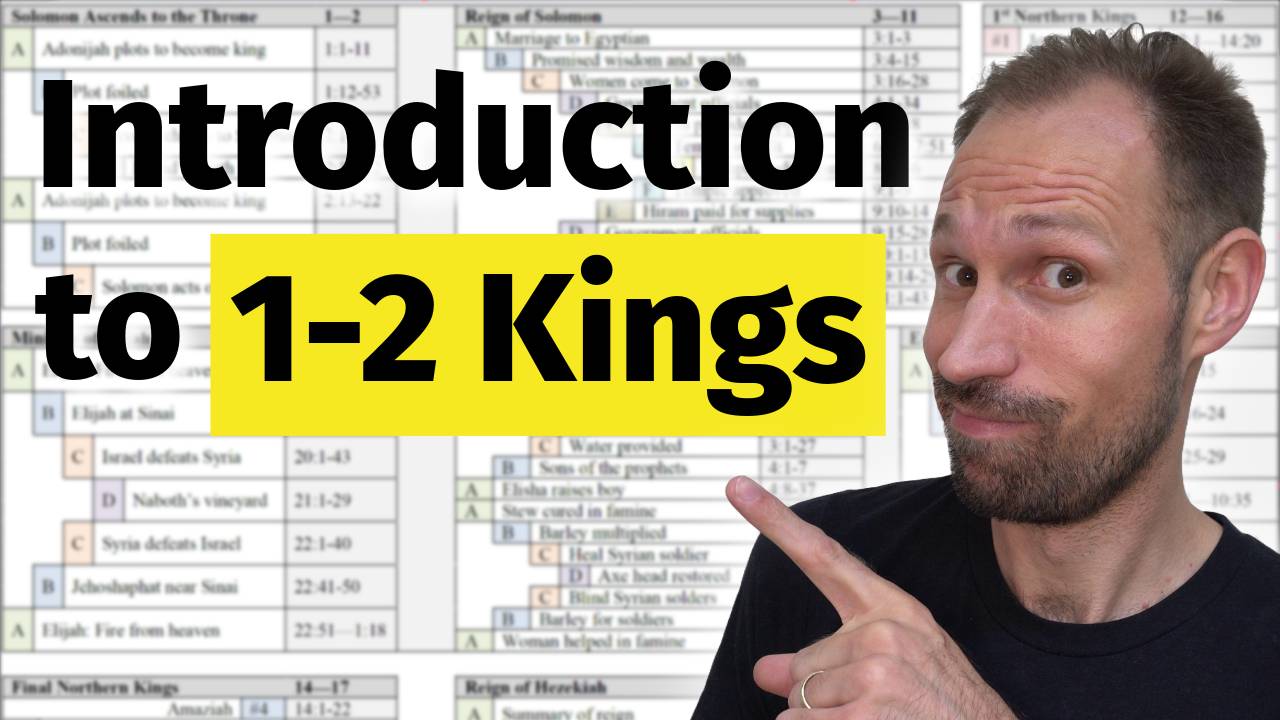
To the casual reader, the books of 1 and 2 Kings can feel like a dizzying carousel of names, dates, and repetitive failures. We move from the gold-paved streets of Solomon’s Jerusalem to the smoke of the Babylonian exile, often losing the thread of the narrative in a thicket of civil war and ancient geography. However, when we step back and view the "macro-structure" of these books, a stunning symmetry emerges. This isn't just a chronological record; it is a divinely inspired architectural feat that uses patterns and parallels to point us toward the ultimate King.
🎥 Watch the Full Video Analysis Here
The Architect of History: Understanding the Structure
In this study, we lean on the literary insights of David Dorsey to show that 1 & 2 Kings is meticulously organized around a chiastic and numerical framework. The history of the monarchy isn't random; it is a carefully curated apologetic for God’s righteousness.
- The Solomon Symmetry: The reign of Solomon (1 Kings 1–11) acts as a "New Adam" narrative. In 1 Kings 3, he is granted wisdom to discern good and evil, and his kingdom becomes a prophetic template for the future Messianic Kingdom. We see this in the wealth of the nations flowing to Jerusalem (1 Kings 10), an event Isaiah later uses in his prophecy of the restored Zion (Isaiah 60:5-11).
- The Power of Seven: The author uses specific numbers to group the kings. There are exactly seven kings of Israel listed before the arrival of Elijah, and a final collection of seven kings that leads to the fall of Judah. This structure emphasizes that the timing of judgment and grace is firmly in God's hands.
- The Prophet Parallel: A central portion of the books focuses on Elijah and Elisha. We explore how Elisha received a "double portion" of Elijah’s spirit, resulting in 14 miracles compared to Elijah’s 7. Many of these directly prefigure the ministry of Jesus, such as multiplying bread (2 Kings 4:42-44) and raising a widow's son in the city of Shunem—the same location as the New Testament city of Nain.
- The Downfall and the Ray of Hope: The narrative tracks the spiritual decline leading to the Battle of Carchemish and the eventual destruction of Jerusalem. Yet, the book ends not with total despair, but with King Jehoiachin being released from prison and dining at the table of the King of Babylon (2 Kings 25:27-30)—a subtle sign that the line of David remains intact.
Mapping the Monarchy
Visualizing the overlapping reigns of the Northern and Southern kingdoms is essential for grasping the author's intent. The macro-structure chart provided with this study clarifies these complex timelines and highlights the literary hinges that connect the rise of the prophets to the fall of the kings. It serves as a visual guide to seeing the "big picture" of the 400-year monarchial period.
📥 Access the 1 & 2 Kings Macro-Structure Chart
Application: A Kingdom That Cannot Be Shaken
The primary function of 1 & 2 Kings is to explain why the exile happened: it was the faithlessness of the people, not the weakness of their God. For the modern reader, this is a sobering reminder of the importance of covenant loyalty. However, it also offers profound hope. If the prosperity of Solomon and the miracles of Elisha were merely "previews," how much greater is the reality found in Jesus Christ? We serve a King who did not fail, and whose kingdom—unlike those of Israel and Judah—will never end.
