
The Architect’s Blueprint: Finding the Chiastic Symmetry in Ephesians 1–3
Mar 07, 2026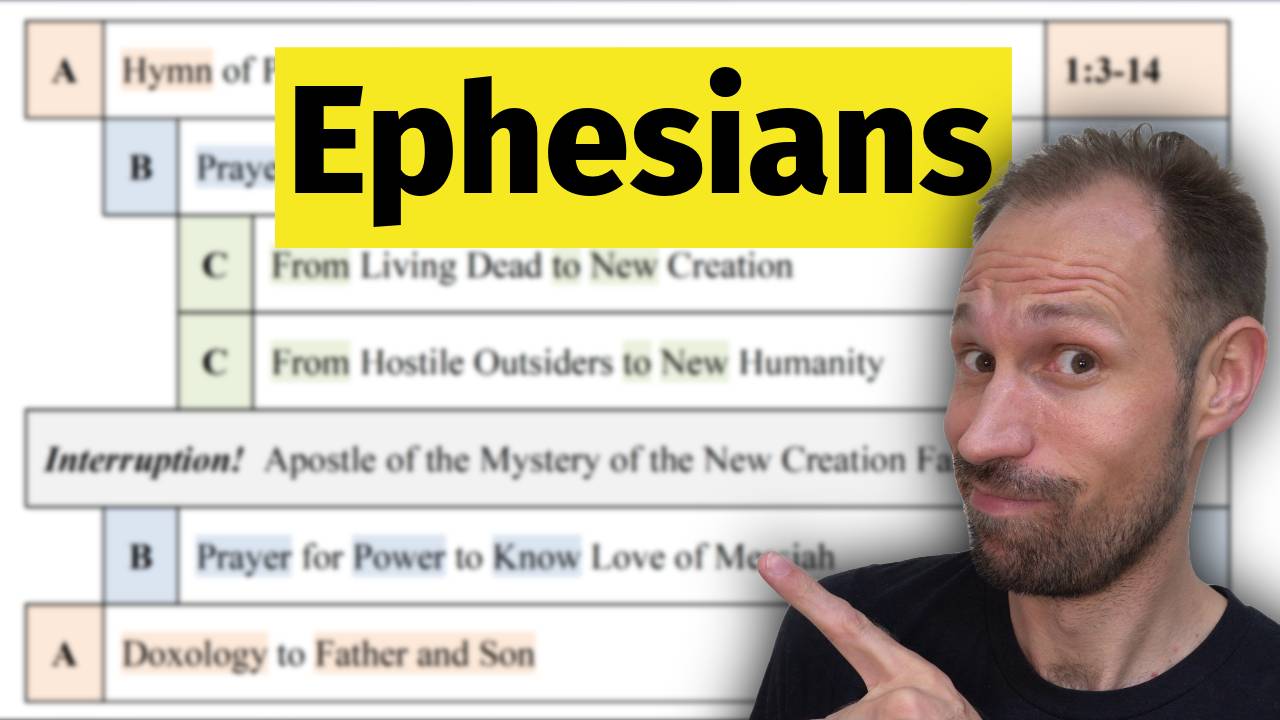
Have you ever felt like the first three chapters of Ephesians are a beautiful, yet overwhelming, landslide of theological concepts? Paul’s sentences are famously long—sometimes lasting for dozens of verses—making it easy to lose the "forest for the trees." However, when we step back and look at the literary architecture, we find that Paul isn't just rambling about the cosmos; he is building a chiasm. This ancient symmetrical structure acts like a spotlight, drawing our eyes away from the edges and toward the absolute heartbeat of the letter: the creation of a new, unified humanity in Christ.
🎥 Watch the full breakdown here
The Structure of the Mystery
In the video, we explore how Ephesians is divided into two distinct movements: Doctrine (Chapters 1–3) and Practice (Chapters 4–6). Paul signals the transition from the indicative (what God has done) to the imperative (how we should live) with a massive "therefore" in Ephesians 4:1. But the first half of the letter is where the "heavenly" heavy lifting happens.
By mapping out the chiasm of the first three chapters, we can see how Paul mirrors his arguments to emphasize God's grand design:
- The Trinitarian Hymn & Doxology: Paul begins in Ephesians 1:3–14 with a "New Covenant Psalm" praising the Father (who chose us), the Son (who redeemed us), and the Spirit (who seals us). This finds its mirror image in the glorious Trinitarian doxology at the end of chapter 3.
- The Prayers for Apocalypse: We see two parallel prayers for "revelation" (Ephesians 1:15–23 and Ephesians 3:14–21). These aren't about the end of the world, but about an apocalypsis—a lifting of the veil so that believers can perceive the "immeasurable greatness" of God’s power and the "breadth, length, height, and depth" of Christ’s love.
- The Heartbeat (The Center): At the center of this structure lies Ephesians 2, where Paul details the "mystery of His will." He moves from the individual salvation story—being made alive when we were dead in sin (2:1–10)—to the corporate salvation story: the breaking down of the "dividing wall of hostility" between Jew and Gentile (2:11–22).
Visualizing the Text
Seeing these parallels visually changes how you read the text. For instance, noticing that Paul’s prayer for "inner strength" in chapter 3 mirrors his praise for "Christ’s resurrection power" in chapter 1 helps us realize that the power that raised Jesus from the dead is the same power currently at work within the believer. This isn't just a literary trick; it's a theological statement about the consistency of God's work in the cosmos and the church.
To help navigate these dense chapters, I’ve put together a structural map that aligns these matching sections (A, B, C) side-by-side. It’s a helpful companion for your personal study or for teaching through the book.
📜 Access the Ephesians Structural Chart
Application: Walking Worthy
The beauty of the Ephesians chiasm is that it reminds us that our "walk" (the ethics of chapters 4–6) is grounded in a "calling" that is perfectly ordered and secured by the Trinity. We don't strive for unity because we hope to achieve it; we walk in unity because Paul shows us that, in the center of God’s grand design, He has already made us "one new man." When we understand the symmetry of what God has joined together, we find the strength to live out that reality in our daily lives.
