
The Hidden Key to 1 Corinthians: The Structure That Explains Everything
Jan 24, 2026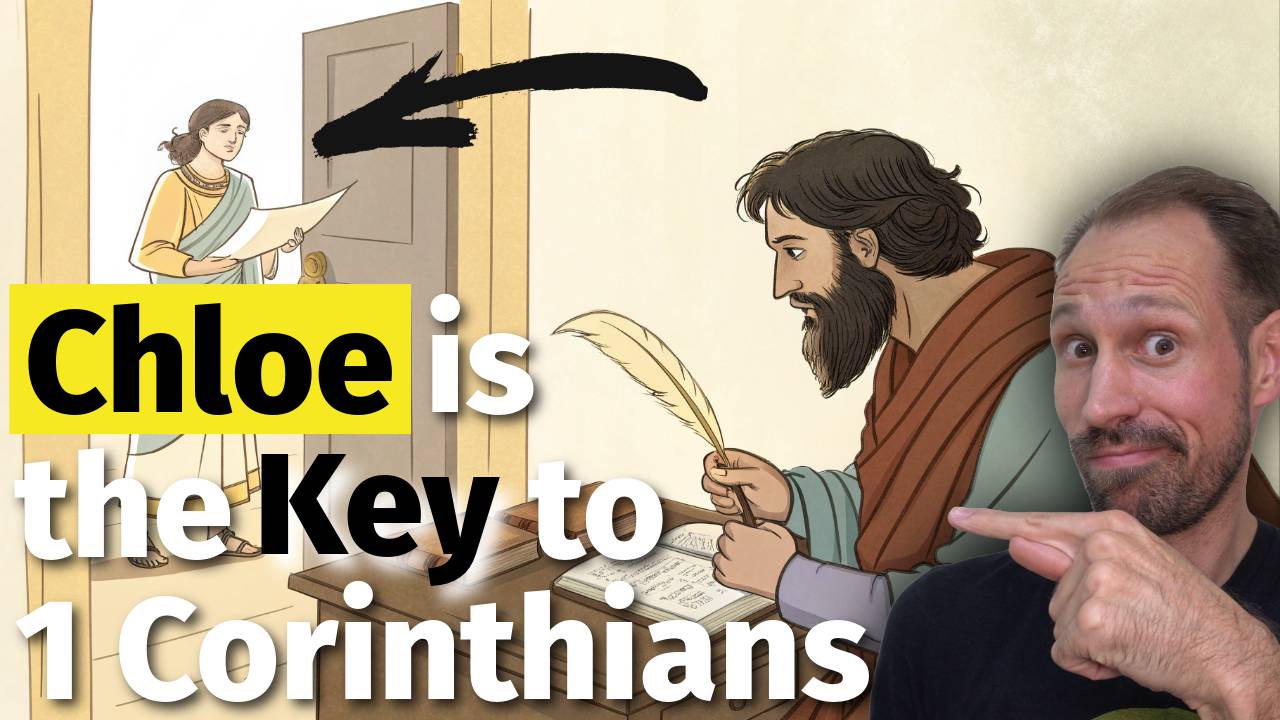
Ever picked up 1 Corinthians and felt like you were reading a disorganized list of problems? From sexual misconduct to lawsuits, and from spiritual gifts to head coverings, the letter seems to jump randomly between topics. For centuries, scholars have noted its chaotic nature—it's arguably the most jumbled letter Paul ever wrote. But what if that seeming chaos is actually a brilliant, laser-focused structure?
The key to unlocking the entire book lies with one person you’ve likely never paid attention to: Chloe.
🎥 Watch the full video to unlock the structure of 1 Corinthians
🔑 Chloe's Report and Questions: The Structural Framework
The entire letter of 1 Corinthians is not a random rant from Paul; it’s a direct, organized response governed by two crucial pieces of communication brought to Paul in Ephesus by Chloe and her household: a verbal report and a written list of questions from the Corinthian church.
The letter neatly divides into two sections based on these communications:
- Part 1: Chloe’s Report (Chapters 1–6): This section addresses the news Paul heard about the divisions and disorders within the church.
- Divisions and Factions: Chloe's people reported this first in 1 Corinthians 1:11 ("It has been reported to me by Chloe’s people..."). The divisions were centered on leaders like Paul, Apollos, and Cephas (1:12), showing a misguided emphasis on human wisdom and impressive rhetoric.
- Immorality and Lawsuits: This section also confronts the shocking issues of incest (Chapter 5) and Christians suing one another in secular courts (Chapter 6).
- Part 2: The Corinthians’ Questions (Chapters 7–16): Paul uses the phrase "Now concerning..." to introduce each new question that the Corinthians specifically asked him, providing a clear map of their concerns.
- Marriage and Sexuality: "Now concerning the matters about which you wrote: It is good for a man not to touch a woman" (7:1).
- Food Sacrificed to Idols: "Now concerning food offered to idols..." (8:1). Paul addresses whether Christians can eat meat from the local market previously dedicated to Greek gods.
- Spiritual Gifts: "Now concerning spiritual gifts, brothers, I do not want you to be uninformed" (12:1). This leads to the famous discussion of love (Chapter 13) and the proper use of tongues and prophecy (Chapter 14).
- The Collection: "Now concerning the collection for the saints..." (16:1).
🕊️ The Unifying Theme: Spiritual Confusion
These diverse problems—from lawsuits to tongues—are unified by a single root issue: The Corinthian believers were deeply confused about what it means to be spiritual.
- Misunderstanding Wisdom and Spirituality
The Corinthians believed they had achieved high spiritual maturity and wisdom (Chapters 1–2), often demonstrated through their eloquent preachers. Paul demolishes this proud assertion:
- True Spirituality is United: As long as there is "jealousy and strife" (3:3), it proves they are "people of the flesh," acting as "merely human" (3:4).
- True Wisdom is the Cross: Wisdom is not found in "lofty speech" (2:1) but in "Jesus Christ and him crucified" (2:2). This wisdom of the cross is humble and self-denying, the opposite of their proud division.
- True Spiritual Gifts are Loving: Paul presents love as the "more excellent way" (12:31). True spirituality overflows in love (Chapter 13) which creates unity, standing in contrast to the pride they took in visible gifts like tongues (13:1, 8).
- Devaluing the Body
The second symptom of their confusion was a dualistic worldview—they assumed the spiritual mattered, and the physical/body was either irrelevant or evil. This led to two opposing errors:
- Asceticism: If the body is evil, then activities like sex should be severely limited (Chapter 7).
- License: If the body doesn't matter, then sexual sin like visiting a prostitute is acceptable because it won't affect the 'spiritual' self (6:13). Paul corrects this with the profound truth that your physical body is literally a "temple of the Holy Spirit" (6:19).
- The Resurrection: This worldview culminated in questioning the very doctrine of the physical resurrection (Chapter 15). Paul powerfully corrects them, emphasizing that the body is good, God created it, and one day it will be raised "not perishable but imperishable, not weak but powerful!" (15:42–43).
This deep-dive into Paul’s original purpose reveals that 1 Corinthians is not a mess, but a carefully constructed, masterful piece of instruction on how to live out a unified, humble, Christ-centered, and embodied life of faith.
This video utilizes a simple visual chart to help you follow along, mapping Chloe's inputs to Paul's responses throughout the entire letter. Seeing this outline clarifies how all the pieces fit together.
📜 Download the Structural Outline Chart
💡 Concluding Application
The issues the Corinthians faced are strikingly relevant today. We still struggle with divisions over favorite leaders, pride in our perceived spiritual maturity, and confusion over how our physical lives intersect with our spiritual faith. By understanding Chloe’s role, we gain a clear, executable framework for studying 1 Corinthians, allowing Paul’s powerful message of the cross and love to finally snap into focus.
