
The Secret, Tragic Purpose of David's Mighty Men in 1 & 2 Samuel
Jan 24, 2026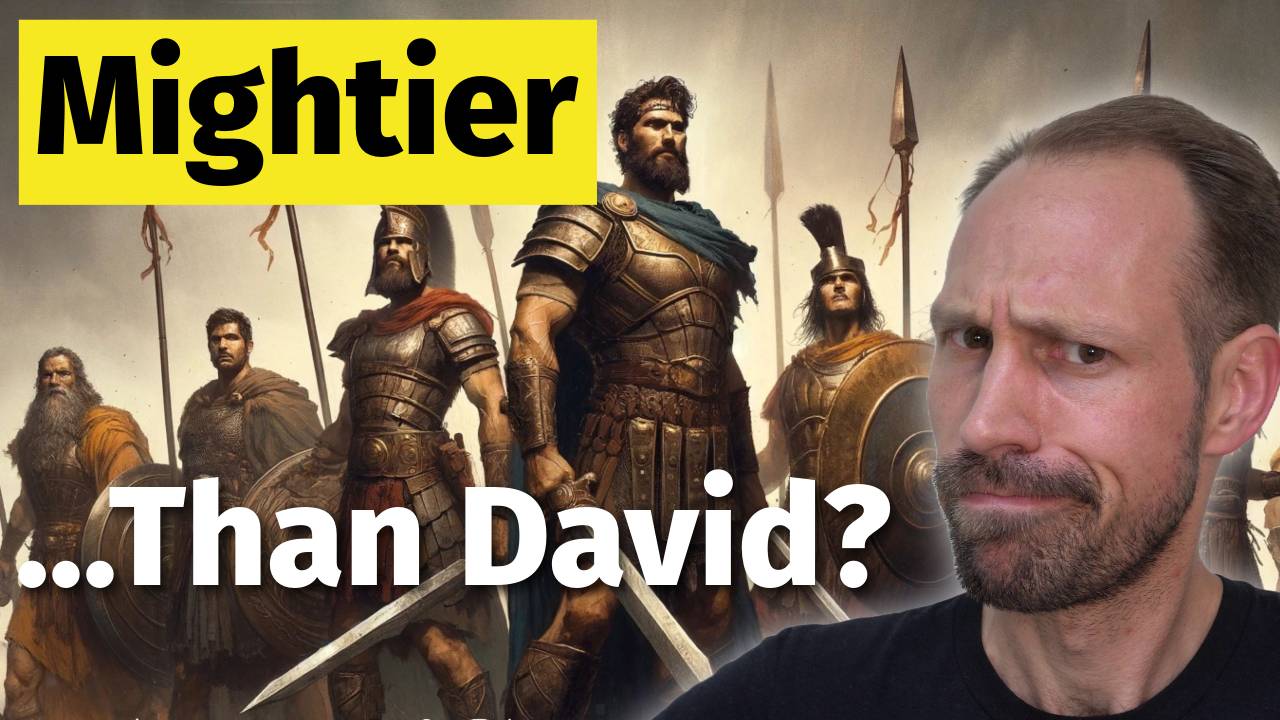
Have you ever read the accounts of David's Mighty Men and felt like you were reading an ancient action movie script? Figures like Benaiah, who killed a lion in a snowy pit (2 Sam. 23:20) and took down an Egyptian giant with only a stick, or Josheb-basshebeth, who slew 800 men with his spear (2 Sam. 23:8), possess a formidable, almost superhuman strength. These narratives of conquest and valor are captivating, but their placement and function within the books of 1 and 2 Samuel is often misunderstood. Far from being simple hero stories, these chapters serve a profound, even tragic, biblical purpose: they highlight the profound weakness of the very king they served, pointing the reader toward the need for a sinless, greater-than-David Messiah.
🎥 Watch the video on David’s Mighty Men
The Divine Blueprint: From Saul's Failure to David's Weakness
To understand the Mighty Men, we must first understand the narrative arc of the kings of Israel. The story begins with the people’s demand for a king "like all the nations" (1 Sam. 8:5), a request God warned was a rejection of His own kingship (1 Sam. 8:7). This initial choice, Saul—whose name literally means "the one asked for"—ultimately failed because he did not keep the Lord's command (1 Sam. 13:13-14) and listened to the voice of the people rather than the voice of the Lord (1 Sam. 15:22).
God then chose David, a "man after his own heart" (1 Sam. 13:14), who waited patiently for God to exalt him, even sparing Saul’s life twice. David's life represented the pinnacle of biblical kingship when God established an eternal covenant with him and his descendants (2 Sam. 7:11-16). This is the high point of the entire book.
Tragically, David had his own fall moment in 2 Samuel 11 through adultery and murder. The author models this transgression after the fall of Adam in Genesis 3, showing how David "saw... took... and knew." As a consequence, the prophet Nathan declared that "the sword shall never depart from your house" (2 Sam. 12:10). The following chapters show David’s kingdom fracturing, portraying the great king as a sad and broken man forced to flee his own son, Absalom.
The Strength of the Heroes and the Frailty of the King
This is where the accounts of the Mighty Men in 2 Samuel 21 and 23 become so crucial. Their stories are deliberately emphasized to push David out of the spotlight, exposing his frailty. Eleazar, whose hand stuck to his sword after defeating the Philistines alone (2 Sam. 23:9-10), stands in stark contrast to the king he serves.
📥 Download the overview of David’s Mighty Men here
In fact, the text embeds clear examples of David's weakness directly within the hero lists. In chapter 21, the text explicitly states that while fighting, "David grew weary" (2 Sam. 21:15), and he would have been killed by a giant if his nephew Abishai hadn't come to his rescue. In chapter 23, David expresses a profound, almost pathetic longing for water from his own hometown well (2 Sam. 23:15), a place he was too weak to retake, forcing his three mighty men to break through enemy lines for him.
The list of these mighty warriors ends ominously with the name Uriah (2 Sam. 23:39), bringing the reader back to David's first great failure—his adultery and subsequent murder of Uriah. This serves as a literary bridge to David's final sin in the following chapter: the disastrous census (2 Sam. 24). David, having lost confidence in God, relied instead on his own strength by numbering his army.
Looking to the Greater King
The narrative of 1 and 2 Samuel ultimately tells the story of a flawed monarchy that repeatedly rises and falls. The failures of Saul, and even the tragic failures of God’s anointed king, David, serve a singular, powerful purpose: they demonstrate that no mere man is sufficient to restore the kingdom. The stories of the formidable Mighty Men only amplify this realization. We need a king who will not only be "after God's own heart" but who will be greater than David—a Messiah who will not rise and fall, but will only rise and reign in perfect, sinless righteousness, offering his life as a final atonement for his people.
